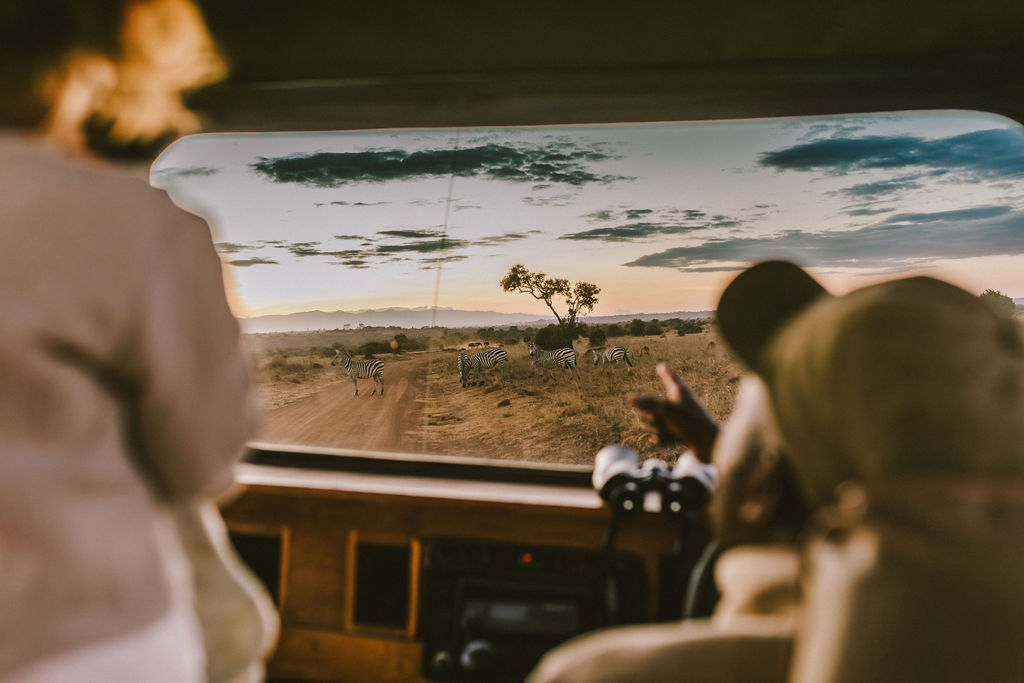
Safari has always been about patience, distance, and respect. Watching wildlife on their terms, not ours. But in recent years, one small object has started to change the way safaris play out in the bush, the mobile phone.
We all want the perfect photo to show friends and family back home. That moment when a lion lifts its head, an elephant crosses the road, or a leopard appears in the branches. But relying only on a mobile phone can unintentionally put pressure on guides, wildlife, and fragile ecosystems.
The value of binoculars
One of the simplest and most underrated safari tools is a good pair of binoculars.
Wild animals are often far away, partially hidden, or blending into the landscape. Binoculars allow you to observe behaviour from a respectful distance without needing to move closer or reposition the vehicle. You see more, not less.
We strongly recommend guests bring their own binoculars if possible. If not, you can always share with your guide, who will usually have a pair on hand. Binoculars slow the experience down and encourage observation rather than pursuit.
Why traditional cameras still matter
The same applies to cameras.
A traditional camera with a decent zoom or long lens is designed for wildlife photography. Animals are rarely close, and that is exactly how it should be. A proper lens allows you to capture intimate moments without crowding animals or altering their behaviour.
Mobile phones, by contrast, work best at very close range. This often leads to guests wanting to edge closer, reposition vehicles, or ask guides to push limits to get the shot. Even when intentions are good, the cumulative effect matters.
The pressure mobile phones create
Wildlife filmmaker Bertie Gregory has spoken openly about the unintended impact mobile phones are having on wildlife encounters. The constant need to get closer for a photo changes animal behaviour, disrupts natural patterns, and increases stress on both wildlife and guides.
On safari, this pressure doesn’t just affect one vehicle or one moment. It influences how roads are used, how animals are approached, and how ecosystems are respected. Guides are placed in difficult positions, balancing guest expectations with conservation ethics.
A better safari mindset
At Ololo Safaris, we believe the best safari moments are often the quiet ones. Watching through binoculars. Listening. Waiting. Letting wildlife come to you.
Photos are wonderful memories, but they should never come at the cost of the experience itself or the wellbeing of the animals we come to admire.
By bringing binoculars, using proper cameras, and being mindful of distance, guests help protect the very magic they’ve travelled so far to experience.
In many ways, the most powerful souvenir of a safari isn’t a photo on your phone. It’s the memory of how it felt to truly observe wildlife, patiently, respectfully, and on their terms.

 Kenya
Kenya